
The Complete Sikh Wedding Timeline Guide for Melbourne Couples — What to Plan, What to Avoid and What to Never Skip
Start With a Real Timeline — Not an Optimistic One
A Sikh wedding day typically runs from early morning to late night. That's a long day with a lot of moving parts and a lot of people who all have opinions about what happens next.
The couples who end up with the most beautiful photos and videos are not the ones with the most expensive outfits or the biggest venue. They're the ones who planned their day with a realistic timeline and stuck to it. Everything else — the light, the moments, the emotion — falls into place when the structure is right.
Here's what a workable Sikh wedding day looks like:
Morning getting ready — 2 to 3 hours minimum for the bride, 1 hour for the groom. Not rushed, not squeezed.
Milni — 30 to 45 minutes. It always runs longer than planned.
Anand Karaj ceremony — 1.5 to 2.5 hours depending on the Gurudwara.
Family formals and couple portraits after the ceremony — 60 to 90 minutes minimum. More on this later.
Vidaai — plan at least 30 to 45 minutes. It is never quick.
Travel and reception prep — build in a genuine buffer here, not five minutes.
Reception — 3 to 4 hours minimum coverage.
Now, with that structure in mind — here are the mistakes that quietly ruin timelines and photos, and how to avoid every single one.
Booking a Gurudwara Hall That's Too Small
This one affects everything and most couples don't realise it until they're standing inside on the day.
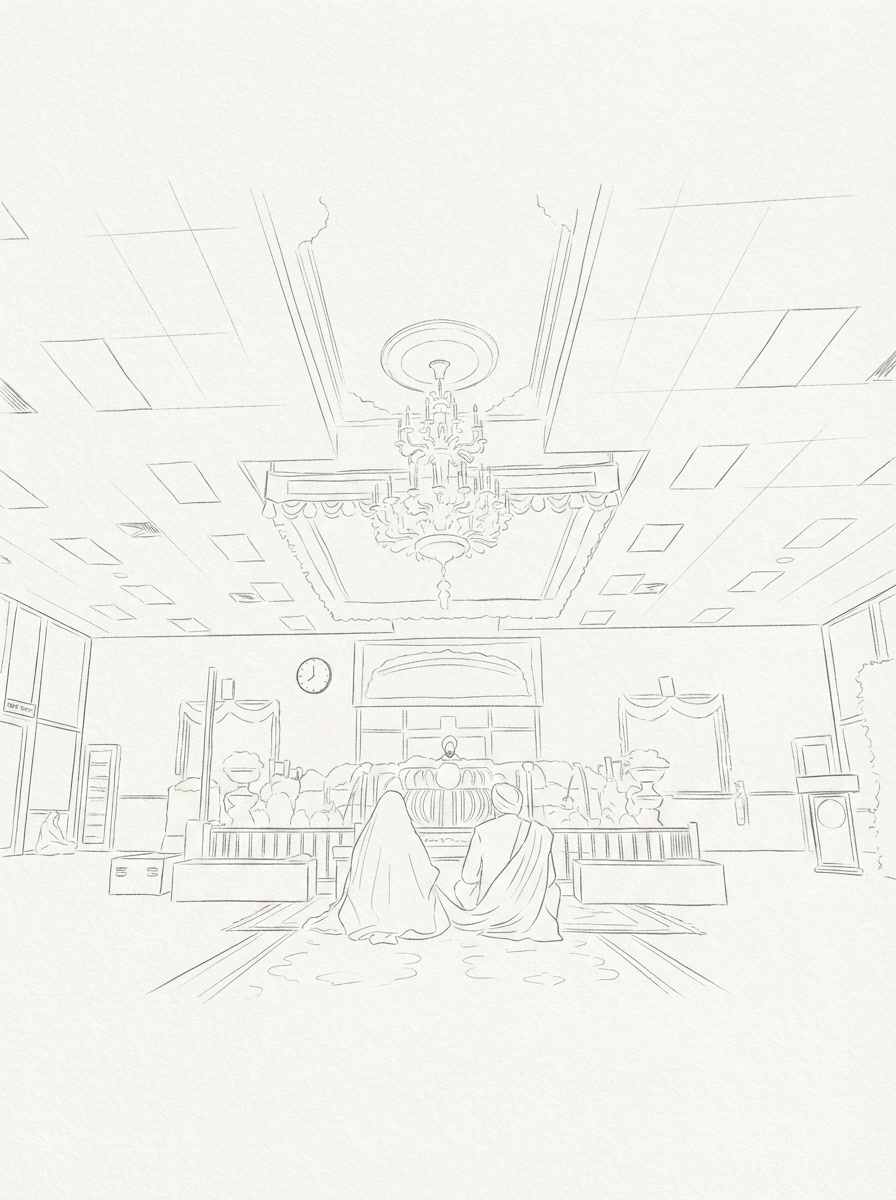
Small Gurudwara halls create real problems for photography and videography. When the space is tight, guests are packed in close together, the photographer has no room to move, and the angles available are severely limited. Instead of wide, open shots of the ceremony with the Guru Granth Sahib Ji as the backdrop, you end up with cramped frames and people in every shot who shouldn't be there.
Small halls also tend to have harsher, lower-quality lighting because there's no space for natural light to come in from multiple directions. Your photos end up looking flat and yellow regardless of how good your photographer is.
When you're visiting Gurudwaras to book, walk into the Darbar Sahib and ask yourself honestly — if 150 people sit in here, will there be any space left for a photographer to move? If the answer is barely, consider a larger venue or manage your guest list accordingly.
Not Checking the Sehra and Kalangi Before the Day
This one sounds small. It is not small.
The sehra is one of the most photographed elements of the entire groom's getting ready. It frames his face in almost every portrait shot. If the sehra starts falling apart — flowers wilting, structure collapsing, ties coming loose — within the first hour, those portraits are compromised for the rest of the day.
Same with the kalangi. If it's not properly secured to the turban, it shifts, tilts, or falls entirely. And unlike a dress that can be pinned back in two minutes, a kalangi that comes loose mid-ceremony is genuinely difficult to fix without completely unwrapping the turban.
What to do: do a full check the evening before. Wear the sehra for 20 minutes. Move around. Make sure the flowers are fresh-sourced the morning of, not the night before. Have the kalangi pinned and checked by whoever tied the turban, not just placed on top and hoped for the best.
Coming Up With New Plans on the Wedding Day
This one happens more than you'd think and it quietly derails everything.
The morning of the wedding is not the time to decide you want photos at a different location, or that you'd like to add a particular ceremony segment that wasn't discussed, or that the timeline needs to shift by an hour because someone had a new idea.
Every unplanned change creates a chain reaction. A location change means travel time nobody accounted for. An added ceremony segment pushes everything back. A timing shift means the couple portrait session now happens in harsh midday light instead of golden hour.
Your photographer and videographer have prepared for what was planned. New plans on the day mean they're improvising with no preparation, and improvised coverage on a wedding day always shows in the final result.
Lock your plan at least two weeks before. Share it with every vendor. Then trust it.
The First Entry Into the Gurudwara — Where Most Mistakes Happen
The groom's entry into the Gurudwara — walking in with the baraat, approaching the Guru Granth Sahib Ji for the first time — is one of the most photographable moments of the entire day. And it is consistently one of the most chaotic.
Here's what goes wrong:
Family members walking directly in front of the camera because they want to see the groom come in. The photographer ends up with backs of heads instead of the moment.
People on their phones with screens up blocking sightlines.
The groom walking too fast because he's nervous or being rushed by someone who doesn't realise the photographer needs him to slow down.
The baraat arriving in a disorganised cluster instead of giving the groom his own space to enter.
What to do: brief the family the night before or morning of. Tell them the photographer needs a clear path during the entry. Ask the baraat to let the groom have his moment rather than surging forward together. It takes 30 seconds to explain and it makes a significant difference to what you end up with.
Not Giving the Couple Space During the Lavaan
Then there's the bride's first entry into the Gurudwara. This is one of the most significant and beautiful moments of the entire day — and it is almost always rushed by the people around her.
Before she has even had a chance to walk in with presence, settle herself, and approach the Guru Granth Sahib Ji in her own time, people surge in front of her to bow down first. She hasn't found her footing, she hasn't had her moment — and the shot that should show her walking in with grace, taking her first bow as a bride, is already gone because ten people stepped across her before she even sat down.
This is her first time entering as a bride. That walk, that bow, that moment of stillness in front of the Guru Granth Sahib Ji — it belongs to her. Brief your family the evening before. Let the bride enter and settle first. Everyone else can follow.
Ask your family beforehand to give the couple space during the rounds. Let the photographer and videographer do their work from a respectful distance. The most powerful images of the lavaan come when the couple looks calm, present, and undirected.
Leaving the Vidaai to the Last Minute
The Vidaai is one of the most emotional moments of the entire wedding. It is also consistently the most under-planned.
What typically happens: the ceremony finishes, everyone eats langar, family photos happen, and then suddenly someone remembers the couple needs to leave and the reception venue is waiting. The Vidaai gets squeezed into whatever time is left — usually fifteen minutes when it deserved forty-five.
A rushed Vidaai means a rushed goodbye. Emotions are real but there's no time to let them breathe. The bride hasn't had a genuine moment with her parents. The photographer is trying to capture something while everyone is already moving toward the cars.
And critically — once the Vidaai is done, the couple needs to leave for portraits and reception prep. If the Vidaai eats into that time, couple portraits either don't happen or happen in ten minutes. Ten minutes is not enough.
Plan the Vidaai into your run sheet as a real segment with real time. Tell family what time it is happening. Do not let it become an afterthought.
The One Person Who's in Every Single Shot
Every wedding has one. The uncle who is absolutely thrilled to be there and expresses it by appearing in the background of every photo and every video clip. Standing behind the couple during portraits. Walking through the frame during the ceremony. Leaning into group shots uninvited.
This is not malicious — it comes from pure joy and excitement. But it genuinely affects the final gallery when the same person is visible in forty separate images.
The solution is simple and kind: ask your MC or a trusted family member to quietly manage this on the day. Not embarrassingly, just gently redirecting people who are drifting into coverage areas. Your photographer will silently thank you for it.
A Few More Things Worth Planning For
Phone screens during the ceremony. When guests hold up phones and tablets to record, they show up in your professional footage and photos. Consider asking your MC to make a brief announcement before the ceremony begins — asking guests to be present and let the professional team handle the recording.
Not briefing the turban tier. If the groom's turban is being tied on the wedding morning, make sure it happens early enough and in good light. This is one of the most beautiful sequences of the getting ready coverage — it needs time and space.
No outdoor portrait location scouted. If you want couple portraits outside after the ceremony, know where you're going before the day. Driving around looking for a nice spot while the clock is ticking is one of the most common ways portrait time disappears.
Weather. Melbourne weather is unpredictable. Have a backup plan for portraits if it rains. Ask your photographer what they do in that scenario so you're not problem-solving it on the day.
The Couples Who Walk Away With No Regrets
After 150+ Sikh weddings in Melbourne, the pattern is very clear. The couples who love their photos and videos are the ones who communicated early, protected their timeline, briefed their family on a few key things, and trusted their vendors to do their job.
It is not about having the biggest budget. It is about being intentional.
Your wedding day is happening once. The Anand Karaj, the vidaai, the first look at each other — these moments do not come back. Plan for them like they matter, because they do.
Planning a Sikh wedding in Melbourne and want to talk through your timeline before you lock it in? this is exactly the kind of conversation we love having early.
Ready to chat about your wedding?
📞 Call or WhatsApp: 0403 760 005 📧 Email: ravcinecaptures@gmail.com 🌐 Website: www.ravcinecaptures.com.au/contact-us
