
The Complete Hindu Wedding Guide for Melbourne Couples — What to Plan, What to Avoid and What to Never Skip
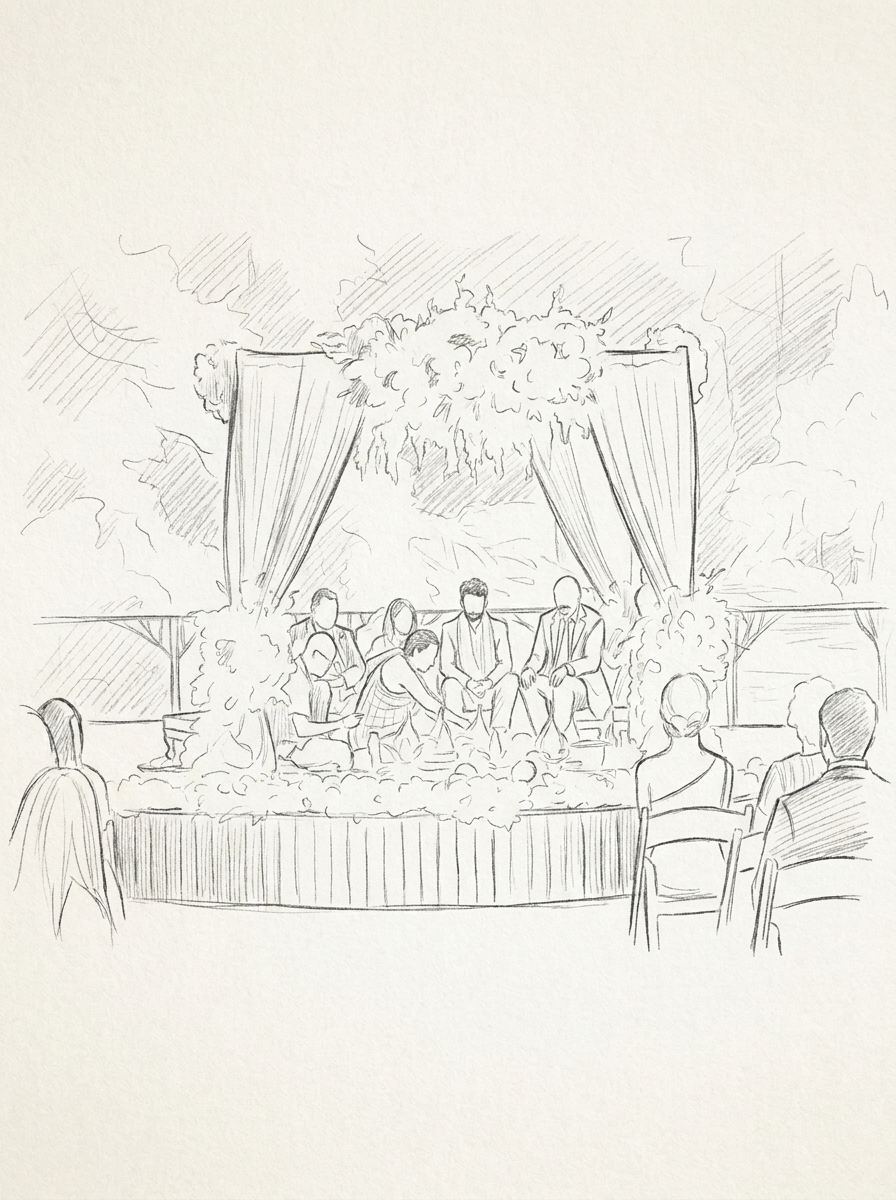
Open Mandap Ceremony
Start With a Realistic Timeline
A Hindu wedding ceremony is one of the most layered and meaningful events you will ever be part of. The rituals — from the Jaimala to the Saat Pheras to the Sindoor — each carry weight and deserve time. When the day is rushed, it shows in every photo and every frame of video.
A workable Hindu wedding day timeline looks something like this:
Bridal prep — 2 to 3 hours minimum. Not squeezed, not rushed.
Groom getting ready — at least 1 to 1.5 hours including pagri and sehra.
Baraat arrival — 45 minutes to 1 hour including the welcome and Jaimala.
Hindu ceremony — 2 to 3 hours depending on Pandit Ji and the rituals included.
Family formals and couple portraits — 60 to 90 minutes minimum immediately after the ceremony.
Vidaai — 30 to 45 minutes. Plan this as a real segment, not an afterthought.
Travel and reception prep — build a genuine buffer here.
Reception — 3 to 4 hours minimum coverage.
Build your day around this structure and protect it. Every section that gets compressed has a cost — and that cost shows up in your gallery.
The Sehra and Pagri — Try Them On Before the Day
The sehra and pagri need to be tried on and worn properly — not just placed on quickly for a photo — before the wedding morning. Wear the pagri for at least thirty minutes. Move around. Sit down. Check that it feels secure and comfortable.
Here is why this matters for your photos and video: if the pagri is uncomfortable, slightly too tight, or sitting at a wrong angle, the groom will unconsciously adjust it all day. The tension shows in his face. The distraction shows in his body language. Instead of being present in his own wedding he is managing his headwear.
The sehra also needs to be checked for durability and fit. If the flowers are wilting by the Jaimala or the sehra keeps shifting in front of his face during the pheras, those portrait moments are compromised.
Sort this the evening before. Check the fit. Check the comfort. Check the durability. It takes twenty minutes and it protects hours of coverage.
Choosing the Right Mandap — This Affects Everything
The mandap is the centrepiece of your entire ceremony. Every significant ritual happens inside it or directly in front of it. Your photographer and videographer will spend more time shooting the mandap than anywhere else on the day. The type of mandap you choose and how it is set up directly determines what is possible in terms of coverage.
Closed Mandap
A closed mandap with four pillars and solid sides creates real challenges. The pillars block sightlines — parents seated inside the mandap get hidden behind a column, the photographer cannot get a clean angle on the couple without a pillar cutting through the frame. Shadows fall unevenly across faces depending on where the light source is relative to the structure.
When the pheras begin and family members are also inside the mandap, a closed structure becomes extremely congested. There is simply no room for a photographer to move, no angle that gives a clear view, and the footage ends up feeling cramped regardless of how well it is shot.
If you are choosing a closed mandap, make sure it is wide enough that two people doing pheras have space to move freely — and that there is enough clearance for your photographer to work from outside without pillars constantly interrupting the frame.
Open Mandap
An open mandap is significantly better for photography and videography. More angles, more light, more ability to capture the couple and the family without obstructions. If you have the choice, an open mandap will almost always produce better coverage.
However — open mandaps come with their own considerations that decorators do not always flag.
Open Mandap in Daylight — The Sun Is Not Your Friend
If your ceremony is happening outdoors or in a space with direct sunlight hitting the mandap, uneven light on faces is one of the most common and most avoidable problems we see.
When one side of the mandap is in direct sun and the other is shaded, half the couple and half the family are lit completely differently. One face is bright and blown out, the other is dark. No editing fixes this because the exposure gap is too wide.
The solution is simple — make sure your mandap has a solid cover on top so that light falls evenly on everyone inside from above rather than hitting from one side. Talk to your decorator specifically about this. Ask them: if the sun is at this angle at 11am, where does the light fall inside the mandap? A good decorator will have an answer. If they don't, it needs to be raised.
Outdoor Mandap — Weather and Heat
If you are planning an outdoor ceremony, weather planning is not optional.
Melbourne weather is genuinely unpredictable. Have a backup plan in writing — not just a vague idea — for what happens if it rains. Where does the ceremony move? Does the decorator have a contingency? Does your photographer know about it? Sort this months in advance, not the morning of.
Heat is a separate issue that does not get talked about enough. If your outdoor ceremony is happening on a warm Melbourne day and your couple and family are sitting in direct or partially exposed sun for two to three hours, it will show in your photos. Perspiration, discomfort, squinting — all of it is visible and it cannot be edited out.
If the ceremony is in summer or during a warm month, prioritise shade inside the mandap. Comfort directly affects how people look and how present they are. A couple who is hot and uncomfortable looks different in photos to a couple who is cool and relaxed.
The Background Behind an Open Mandap
An open mandap looks beautiful in photos when the background works with it. When it doesn't, even the most stunning mandap can look lost.
A plain wall, a garden, a drape, or a floral backdrop behind the mandap gives every shot a clean, intentional frame. When there is no background consideration and the open mandap is set up with a busy room behind it — guests milling around, tables and chairs visible, random furniture in the background — the photos lack depth and focus.
Talk to your decorator about the background before you finalise the mandap placement. Ask your photographer where they would ideally position the mandap in the venue for the best backdrop. This is a simple conversation that significantly improves the final coverage.
Give Your Photographer Space Around the Mandap
This is something almost no couple thinks about during venue and decorator planning — and it causes real problems on the day.
Your photographer and videographer need to move around the mandap during the ceremony. They need to shift from one side to the other, get close for detail shots, pull back for wide shots, and reposition for each ritual. If the mandap is pushed into a corner or surrounded so tightly by seating that there is no clearance to move around it, the angles available become very limited very quickly.
When you are finalising the mandap position with your decorator, ask specifically: is there enough space on all four sides for two camera operators to move freely? At minimum, one to two metres of clear space on each side makes a significant difference to what can be captured.
The Saat Pheras — Keep the Mandap Clear
The Saat Pheras are the most sacred and most photographed part of the Hindu ceremony. Seven rounds around the sacred fire, seven vows, seven moments that define the marriage.
They are also the most congested moment at almost every wedding.
As the couple begins the pheras, family members crowd into or around the mandap to watch. Guests stand up and move forward. Phones go up. What should be a clear, intimate frame of the couple circling the havan kund becomes a wall of people, screens, and backs of heads.
A photographer who cannot move freely around the mandap during the pheras cannot cover them properly. Brief your family before the ceremony — ask them to remain seated during the pheras and let the couple have the space they need. Ask your MC to make an announcement to guests before the ceremony begins.
The pheras happen once. They deserve a clear frame.
Havan Smoke and What It Does to Footage
The sacred fire is beautiful. The smoke it produces can be genuinely difficult for cameras.
When the havan is burning strongly and wind or air conditioning pushes the smoke toward the couple, it fills the frame with haze. In photos it softens the image in a way that looks unintentional. In video it can obscure the couple entirely for several seconds at a time.
This is not something that can be fully controlled — it is a live fire. But it is worth being aware of so your expectations are realistic. Shots taken when smoke is heavy will look different to shots taken in a clear moment. Your photographer will work around it as best as they can but some frames will be affected.
No Last Minute Ritual Inclusions
Hindu ceremonies already involve a significant number of rituals. Adding things the morning of — or mid-ceremony — creates timing problems that flow through the entire rest of the day.
If there is a ritual you want included that wasn't in the original plan, speak to Pandit Ji at least a week before. Understand how long it adds to the ceremony. Adjust your run sheet accordingly. Then tell your photographer and videographer so they are prepared for it.
A ceremony that was meant to run two hours and runs three and a half because of additions on the day means couple portraits are cut short, the Vidaai is rushed, and the reception starts late. Every addition has a downstream effect. Plan for all of it in advance.
Coordinate With Pandit Ji and Set Up Sound for Guests
Two things that get overlooked at almost every Hindu wedding.
First — meet with Pandit Ji before the day. Understand the order of rituals, how long each takes, whether there are any pauses where family needs to be called forward. When your photographer understands the ceremony structure, they can anticipate moments instead of reacting to them. Share your photographer's name and contact with Pandit Ji so they can communicate directly if needed.
Second — set up a speaker or PA system so guests can actually hear the ceremony. A long ceremony where guests cannot hear what is happening creates restlessness. People start talking, moving around, checking phones, drifting toward the back. All of that movement ends up in your background. Guests who can hear and follow the ceremony stay engaged and stay seated.
A simple microphone for Pandit Ji makes the ceremony more meaningful for everyone in the room — and keeps your backgrounds clean.
Decoration That Complements Your Outfits
Your outfits are the visual centrepiece of every photo and video from the ceremony. Your decoration should work with them — not compete with them.
If your bridal lehenga is heavily embellished in gold and deep red and your mandap decoration is also heavily gold and red, everything blends into one busy frame. If your outfit is a soft pastel and your mandap is deep jewel tones, nothing feels cohesive.
Share photos of your outfits with your decorator early. Ask them directly — do these work together? The goal is for the couple to stand out from the decoration, not disappear into it. A great decorator will balance the mandap design so it frames you beautifully rather than competing for attention.
Vidaai and Couple Portraits — Protect This Time
The Vidaai needs to be planned as a real segment — not whatever time is left over at the end of the ceremony. Thirty to forty-five minutes minimum. Tell family what time it is happening. Do not let it become a chaotic afterthought.
Couple portraits need at minimum forty-five to sixty minutes immediately after the ceremony while everyone is still fresh, outfits are intact, and ideally the light is still good. If portraits are pushed to after the Vidaai when emotions are raw and time is gone, what you get is rushed and it shows.
Build both into your run sheet with real time. Protect them from the inevitable schedule creep that happens at every wedding. These are the images you will look at for the rest of your life — treat them accordingly.
Ready to chat about your wedding?
📞 Call or WhatsApp: 0403 760 005 📧 Email: ravcinecaptures@gmail.com 🌐 Website: www.ravcinecaptures.com.au/contact-us
